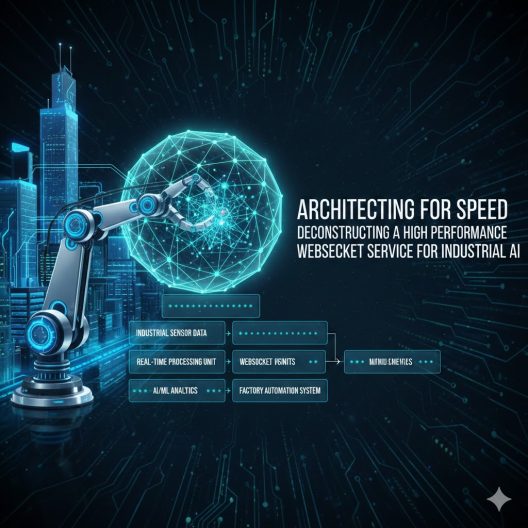





The digital transformation of industrial sectors has created an unprecedented demand for reliable real time communication systems. In environments ranging from financial trading platforms to maritime monitoring systems, the latency and reliability of data transmission directly influence operational outcomes and safety considerations. This research presents the architectural foundation for a high performance communication service specifically engineered for mission critical applications where conventional communication frameworks prove inadequate.
The project’s mission centers on developing a communication backbone that delivers consistent sub fifty millisecond latency while maintaining absolute connection reliability and comprehensive security compliance. This initiative addresses the growing need for industrial grade implementations that can support the exacting requirements of modern real time data distribution.
Key focuses in this project:
1. Performance driven architecture
The architectural design prioritizes a fully asynchronous event driven model that separates connection management, protocol handling, and business logic into discrete components. This separation ensures that each layer specializes in its specific function while maintaining efficient resource utilization.
The system employs non blocking input output operations managed through an optimized event loop, enabling the server to handle thousands of concurrent connections without the overhead of traditional thread per connection models.
Connection pooling and memory reuse strategies further enhance performance by minimizing allocation overhead and reducing garbage collection pressure. The implementation maintains full compliance with the protocol specification while incorporating extensions for enhanced monitoring and management capabilities.
2. Security and reliability considerations
Security implementation begins with mandatory transport layer security encryption for all connections, ensuring data confidentiality and integrity during transmission.
The architecture incorporates a flexible authentication framework that supports integration with enterprise identity providers and national authentication infrastructures. Reliability engineering includes comprehensive heartbeat mechanisms that continuously monitor connection health and automatically detect failed connections.
The system implements graceful degradation procedures that maintain service stability during peak loads or partial system failures. Persistent session management allows for rapid reconnection and state synchronization, minimizing service interruption during network instability or planned maintenance events.
3. Configurable operational framework
Operational flexibility is achieved through an extensive configuration system that allows administrators to tune system parameters without service restart. The server exposes numerous tuning options including thread pool sizing, connection timeouts, memory allocation limits, and protocol specific settings.
This configurability enables deployment across diverse operational environments from resource constrained edge computing scenarios to data center installations with high connection density requirements.
The architecture supports hot deployment of protocol extensions and business logic modules, allowing organizations to adapt the system to evolving operational requirements without service disruption. Comprehensive metrics collection and real time monitoring provide operational visibility into system performance and connection health.
Conclusion
This research demonstrates that through careful architectural planning and performance focused implementation, the technology can meet the stringent requirements of mission critical communication systems.
The presented architecture delivers the low latency, high reliability, and operational flexibility necessary for industrial applications where communication failures carry significant consequences.
The system’s design principles of separation of concerns, comprehensive security implementation, and extensive configurability provide a solid foundation for real time data distribution across multiple sectors.
As industrial systems continue to embrace digital transformation, robust communication frameworks of this nature will play an increasingly vital role in enabling the next generation of operational technology applications.