


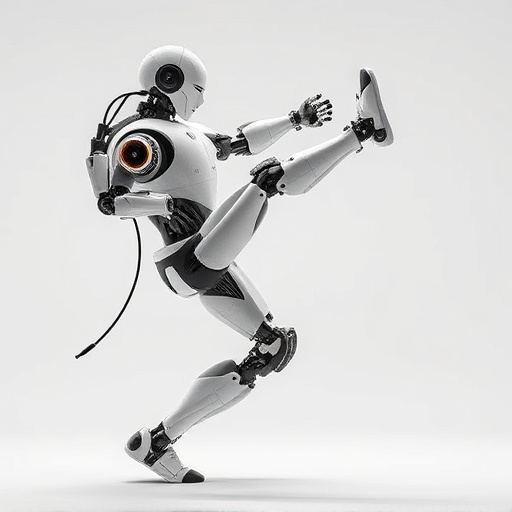
The domain of advanced robotics is undergoing a specialized evolution, shifting its focus from industrial automation to the demanding arena of martial arts. This emerging frontier centers on the development of humanoid robots engineered to execute sophisticated combat techniques.
Chinese technology firms have established a decisive lead in this niche, distinguishing themselves not through military applications but by creating athletic platforms of metal and code. Their widely circulated demonstrations of complex punch combinations, dynamic kicks, and stable rotations represent the foundational programming for a new form of robotic sport.
This lead, largely unchallenged by international competitors, is rooted less in mechanical hardware and more in a critical software innovation: the advanced artificial intelligence agent. These AI systems are the core drivers of a potential revolution in both entertainment and athletic training.
Algorithmic Kinetics: Translating Biomechanics into Code
The tangible achievement is the translation of nuanced human biomechanics into stable, repeatable robotic actions. Companies such as Xiaomi and various agile startups have validated platforms capable of performing precise jab cross hook combinations, forceful roundhouse kicks, and rapid defensive rotations.
These actions are not pre recorded animations but the result of sophisticated software solving problems of dynamic balance, momentum transfer, and multi joint actuator coordination. The objective is to achieve a kinetic fluidity that mirrors a trained martial artist.
This physical fidelity makes the technology viable for structured combat sports environments like MMA or boxing. It also establishes the necessary vessel for the advanced cognitive software that defines the next stage of innovation.
The Cognitive Core: Specialized AI Agents for Physical Strategy
The true innovation lies in the specialized artificial intelligence agents that govern these machines. Unlike AI designed for data analysis or conversation, these agents are architected for the high stakes, millisecond feedback loops of physical combat.
They must process dense sensor data from vision systems and inertial units to perceive an opponent and the environment. Their core function is to make instantaneous tactical decisions selecting strikes, planning evasions, and adjusting footwork for optimal power and stability.
Furthermore, through machine learning frameworks like reinforcement learning, these agents evolve beyond static programming. They engage in simulated and real sparring to develop adaptive strategies, learning effective combinations and opponent exploit patterns. This transforms the robot from a playback device into an autonomous entity capable of tactical learning.
A Concentrated Innovation Ecosystem
China’s progress is magnified by the notable absence of direct global competition in this precise fusion of martial arts and embodied AI. While other nations and corporations pursue humanoid robots for logistics or general assistance, Chinese engineers have concentrated on the combat sports niche with singular focus.
This uncontested space allows them to define the developmental trajectory, merging advances in real time motion planning, predictive simulation, and strategic AI. They operate without the market pressures of a crowded field, enabling rapid iteration.
The result is a deep vertical integration between the AI agent’s decision making and the hardware’s physical execution. This consolidation of software and hardware innovation creates a formidable, holistic advantage.
Redefining Competition Through Intelligent Systems
The integration of these advanced AI agents is catalyzing a dual evolution in competitive paradigms. First, it initiates authentic machine versus machine competition, where victory is determined by the strategic depth, adaptability, and learning efficiency of the underlying AI.
This serves as a profound testbed for developing robust, generalizable embodied intelligence. The challenges of physical combat push the boundaries of real time processing and adaptive strategy in ways that virtual or stationary AI testing cannot.
Second, and more imminently, it redefines human athletic preparation. A robot governed by such an AI becomes an unprecedented training instrument: an analytical sparring partner that never fatigues. It can be programmed to emulate specific fighting styles.
This system applies constant strategic pressure to test a human’s defense and provides objective data on performance biometrics. The competition for human athletes thus becomes a process of accelerated adaptation against an intelligent system designed to challenge their limits.
Conclusion
China’s commanding position in martial arts robotics is a testament to targeted software innovation within a novel application space. By concentrating on the algorithmic replication of combat sports techniques, engineers are solving critical challenges in real time stability and adaptive physical interaction.
The specialized AI agent stands as the pivotal innovation, transitioning these platforms from demonstrative spectacles to functional, learning systems. As these agents evolve from executing pre programmed forms to engaging in intelligent, responsive sparring, they signal a future where athletic training is augmented by machine cognition.
This focused advancement underscores a strategic investment in embodied AI. It positions these engineered combatants at the forefront of a new intersection between ancient physical arts and digital intelligence, redefining the boundaries of both sport and machine capability.