




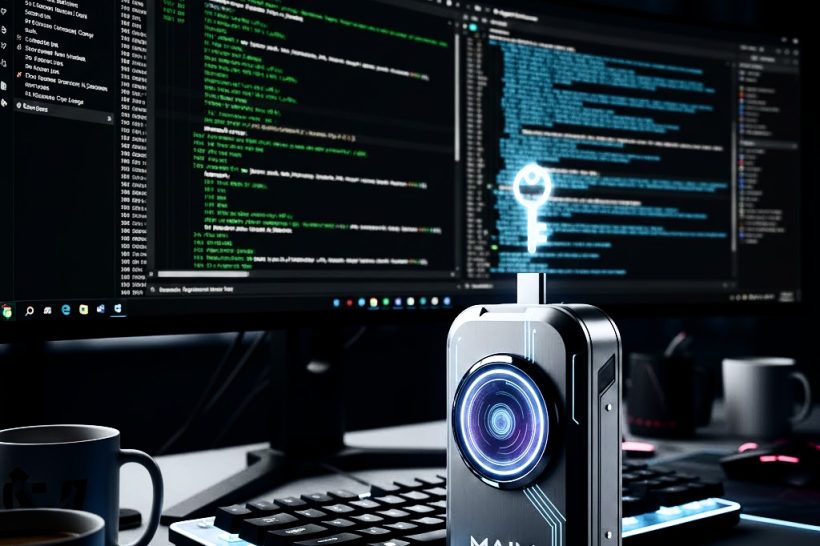
The Magic AI Module (MAIM) represents a novel innovation at the intersection of hardware design, artificial intelligence interaction and expansion with Microsoft Agent Framework or any other Agent Framework implementation.
It is a conceptual portable device that functions as a dedicated physical key, providing secure and seamless access to personalized cloud based AI agents. Its primary innovation lies not in local processing power, but in its ability to deeply and responsibly integrate these advanced features into a user’s most critical digital environment: the command line interface (CLI).
For professionals working within shell environments, including the Windows command line and PowerShell ecosystems, current tools exist in a separate, disjointed layer. The MAIM proposes to solve this by embedding agentic intelligence directly into the terminal workflow.
This integration is designed to be version agnostic, operating as a universal bridge that connects the timeless, text based power of the CLI with the dynamic, cognitive capabilities of modern AI frameworks, thereby creating a new paradigm for human computer collaboration.
The Integrative Bridge
The core challenge in modern technical work is the friction between powerful cloud based artificial intelligence and the precise, stateful environment of the command line interface.
Professionals operate in a text based realm defined by context and sequence, yet they are forced to depart this environment to access AI assistance through generic web portals or separate applications. This constant context switching fragments workflow, introduces security concerns, and prevents the AI from developing a deep, continuous understanding of the user’s tasks and history.
The proposed Magic AI Module addresses this by serving as a dedicated hardware bridge, a physical key that unlocks a secure and integrated pathway between the terminal and a personalized cloud based agent framework. Its primary function is not local processing but providing seamless, authenticated, and context aware access, embedding AI capabilities directly into the command line as a native resource.
Architecture of Contextual Access
The module’s design is predicated on principles of minimal local computation, hardware rooted security, and deep CLI integration.
As an internet dependent device, it leverages cloud infrastructure for heavy processing while maintaining a persistent, cryptographically secure identity through an embedded secure element when connected, it installs a lightweight client that allows the user to invoke its capabilities directly from the shell prompt using simple commands or dedicated hotkeys. Crucially, it can be granted temporary, explicit permission to access relevant contextual data such as the current working directory, command history, or recent error outputs solely to inform the agent’s responses.
This architecture creates a trusted conduit where the user’s intent, expressed in plain language or through flags, is enriched by operational context and securely transmitted to a cloud agent that feels like a natural extension of the shell itself.
Transformative Workflow Applications
This integration enables transformative use cases that redefine CLI productivity. A developer forgetting a complex command syntax can query the module directly in the terminal, receiving an accurate, context specific solution without breaking their flow, when a system deployment fails with a cryptic error, the user can command the module to analyze the log output, receiving a clear diagnosis that identifies the root cause from a cascade of messages.
Furthermore, the module can observe repetitive multi step procedures, allowing the user to later command their execution or modification through natural language, effectively translating demonstrated actions into automated, agent managed workflows.
In each scenario, the module elevates the command line from a static tool of memorized commands to a dynamic interface for conversational problem solving and delegated task execution, all while preserving the security and precision that define professional technical work.
Conclusion
The Magic AI Module is a true innovation because it successfully addresses the fundamental problems of access, context, and trust that currently isolate AI from core technical workflows. As detailed, it solves the access problem by becoming a tangible, always available key that makes powerful AI agents a first class citizen within the command line.
It solves the context problem by creating a secure architectural bridge that allows the AI to understand the user’s immediate digital environment, turning generic queries into precise, actionable commands.
Finally, it solves the trust problem through hardware based identity and ephemeral data handling, making powerful cloud intelligence safe for sensitive work.
Ultimately, the MAIM innovates by redefining the interface itself. It transforms the command line from a solitary, syntax driven tool into a collaborative and intelligent workspace, marking a significant step forward in how humans will command and cooperate with artificial intelligence.